Here is your marketing misfire of the week.
This company takes out a full page ad in TIME magazine, puts in a QR code, but doesn’t even mobile-optimize the landing page!
Those fonts are really tiny.
I usually blog by value, but now, I’m blogging by reference.
With that bad piece of geek humor out of the way, I want to thank Dharmesh Shah for graciously publishing my article on his OnStartups blog.
The comment stream was very interesting. I’m going to experiment and reply in bulk to the major themes, using one comment for each theme:
After 5 years at this company you may have a lot more responsibilities that will make harder time leaving to start your company, like a mortgage and a family. (Don Tarinelli)
While it is easier to put in 80+ hour weeks as a young, single entrepreneur, most entrepreneurs start several companies during their career. Plus, a few years first at another startup doesn’t put most people into mortgage and family territory.
I think many recent graduates treat their first startup like college: “if I don’t do it now, I’ll never do it”. That’s a mistake: startups aren’t like college — many entrepreneurs will do 3-6 over their career.
“There’s just nothing like learning on the job, in context, from those with more experience than you. ” (then hire them)
(John Hadings)
My blog post is really about learning, and it’s very, very hard for young, inexperienced entrepreneurs to hire more senior, more experienced managers. Most people want a boss they can learn from, and it’s a hard sell when your prospective boss has no experience. It can happen (e.g. Facebook), but it’s extremely rare and it almost always follows a business traction breakthrough.
If you wait to start your business you will probably never start it. Rarely have I heard of somebody that gained experience in someone else’s business to learn how to start their own and actually did it. (Bob)
My experience is the exact opposite: most startups I see are by entrepreneurs coming out of another company, striking out on their own for the first time. This is practically the venture capital investment recipe in CA: investing in entrepreneurs with early stage experience in other startups (e.g. Facebook, Google, etc.)
recent grads are better off jumping right in as a CEO of a startup rather than getting pegged as a low-level lackey in an existing company. Warren G. Lewis
This is the mindset that gets many young entrepreneurs into trouble. Sometimes people get more focused on “being CEO” than building the experience for success. The CEO job is the toughest there is, and very few are successful jumping in with no prior experience.
When we started Open Market in 1994, the Internet was pretty much the Wild West. Everyone was figuring out what it “meant”, and it was a time when a 2-person company could have the on-line presence of IBM (and often did).
Now, fast-forward 15 years. We have an Internet ecosystem dominated by the “Gang of Four”: Google, Apple, Amazon, and Facebook. Combined, these “gorilla” companies have a $750 billion market cap, employ over 100,000 people, and extract most Internet revenues and profits. And increasingly, this group is controlling the devices we use to get on-line.
It’s not the Wild West anymore, and the new “GAAF” ecosystem has added new constraints around building Internet companies:
I’m reading Steve Jobs’s biography, and though I’ve heard many of the Apple stories, it’s amazing to me how involved he was in fine details of Apple’s product design. It reminds me that details matter, great products are about details, and great products will make great companies.
It also helps me understand why I reacted so negatively to Gmail’s new design. It’s easy to trash changes (complaining about Facebook UI tweaks is practically a national sport), but I’m trying to put my finger on why it’s so bad.
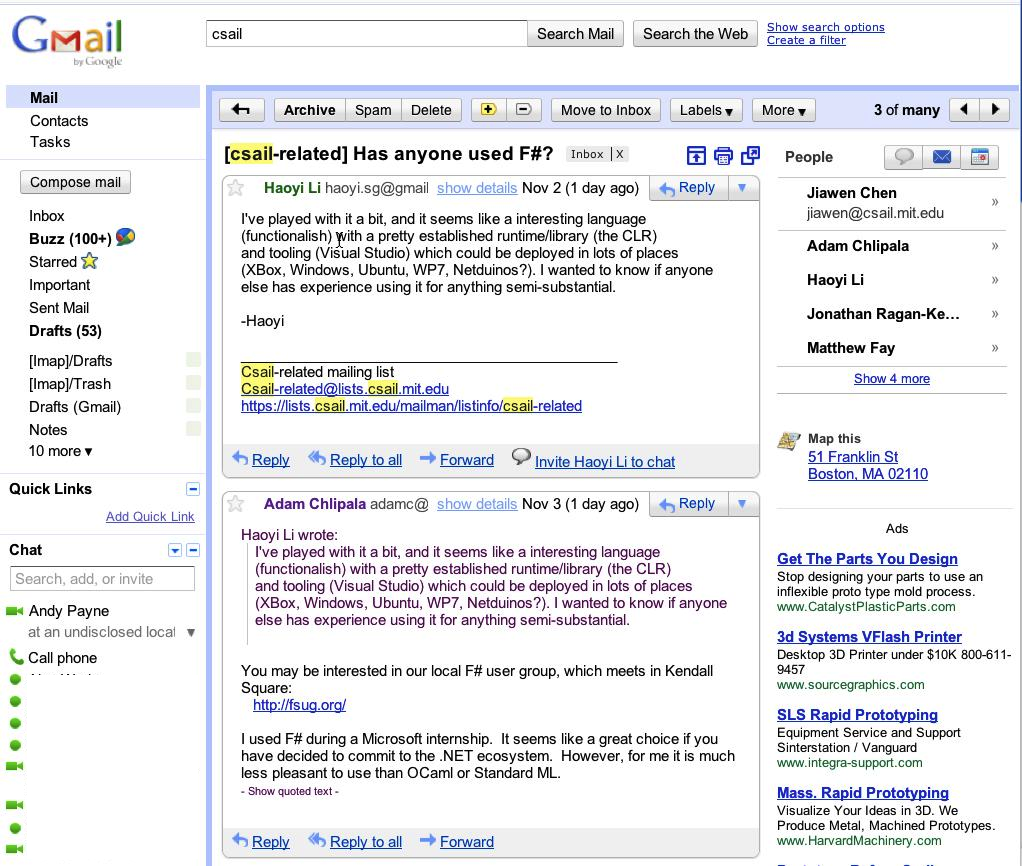
There are some nice usability improvements, such as the ability to reply by just typing into a box. But by going “cleaner”, Google eliminated many of the subtle but essential visual clues that defined page elements. Consider the old design:
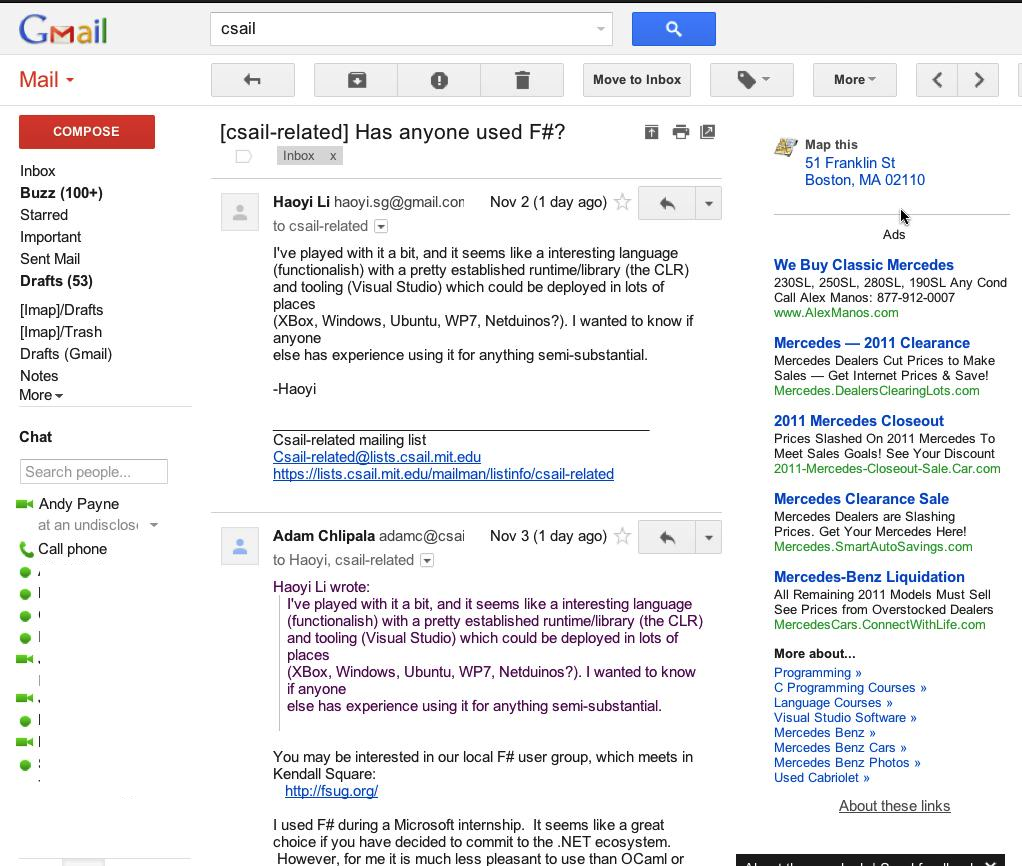
Now, look at the new design:
Note how the most important part (the message body text) gets more “lost” in the page. Button coloring and shading is now too muted, losing important navigation hints. The rounded box around messages is gone, causing more work to figure out where messages end and begin (and it’s even worse when messages contain quoted replies). Sender names are no longer colored, making them harder to find as well. (And themes don’t address the problem — that just provides color and highlighting on the top and left bars).
Considered together, these changes force the user to do much more “visual work”. For an email app, which is often used in a scanning or skimming mode, this is a critical issue. It’s also my biggest problem with many UI designs: most designers do not undertand how our eyes work. They frequently focus on “aesthetics”, and miss important contrast, color, grouping, layout, and flow details.
I hope Google lets us keep the old design!
Steve Yegge’s post about Google’s platform strategy has been making the rounds lately, and buried in it is something very interesting:
Jeff Bezos is an infamous micro-manager. He micro-manages every single pixel of Amazon’s retail site. He hired Larry Tesler, Apple’s Chief Scientist and probably the very most famous and respected human-computer interaction expert in the entire world, and then ignored every goddamn thing Larry said for three years until Larry finally — wisely — left the company. Larry would do these big usability studies and demonstrate beyond any shred of doubt that nobody can understand that frigging website, but Bezos just couldn’t let go of those pixels, all those millions of semantics-packed pixels on the landing page.
Steve Jobs was also an infamous customer experience manager, involved with all Apple products to an intense level of detail. He has his name on over 300 Apple patents.
It think it’s interesting, and not a coincidence at all, that Apple and Amazon are two of the most powerful companies in the Internet ecosystem. In the end, it’s all about the user experience.
It helps when the “CEO” is also the “CUXO”, but it’s not the only way to do it. But it’s hard when there’s not one person that owns the UX, with the authority, vision, drive, charter, energy, charisma, and respect to lead it, throughout the organization. Committees don’t work.

I first read about C in the early 80s in BYTE magazine, when they had a full issue on the language. (According to the archives, it was August 1983). After learning BASIC, pointers and function declarations really opened my eyes. It would be several years before I could actually compile anything, but it quickly became my main development language. My early copy of K&R is quite worn now, and I could quote it, chapter and verse.
In a world of iPhones with one-year half lives, it’s amazing to consider that C has been in use, in nearly original form, for over 40 years, and it’s the basis or major influence for many of today’s mainstream languages. It’s even more amazing that most machine instructions executed world-wide are compiled C (and C++) programs (and I suspect this is by a wide margin).
C is a simple but brilliant language, and Dennis Ritchie taught us the importance of finding solutions and designs that are simple and elegant. We will miss him.
I’ve always loved Netflix. I was a very early subscriber, and we still carry the DVD plan even though we rarely use it (we’ve had some DVDs out for years). And Reed Hastings has done something that few CEOs and companies have done: start business A, then successfully build and enter new business B.
But I think they’ve entered a very vulnerable period. Their streaming deal problems have been well-reported, but there’s a much deeper (and fundamental) issue looming: they don’t control any user “on-ramp”.
The consumerization of access devices, like tablets, mobile phones, and e-readers gives companies like Apple (and soon, Amazon) immense control. In some cases, it’s overt (e.g. lack of Flash support, the app approval process, etc.) In other cases, it’s done by controlling the preferred user experience: given the new subscription support in iOS 5, why would users want to do subscriptions any other way?
It will be increasingly easy (and cheap) to watch movies on Apple and Amazon devices, gradually squeezing Netflix out of the party.
I just upgraded my iPad to iOS 5 — wow! There’s lots of stuff in there.
What’s most interesting are features that Apple’s pulled in from their app ecosystem. This is great for users (Apple gets to cherry-pick the best ideas). But it’s risky for app developers who can see their hard work turn into free features, and then deeply integrated in a way that only Apple can do.
I’m making a running list of who’s impacted:
Long term, I see threats to:
Following up on my work on digital fabrication and related areas, I tried Ponoko’s fabrication service. I didn’t design anything myself (I’m lazy), but I bought a tabbed Arduino enclosure from their marketplace, cut from 3mm clear acrylic.
Here’s the 20cm x 20cm laser-cut sheet I got from them:
The cut width was very fine (Ponoko says the line width is about 0.2mm):
And here’s the final case (not glued, and assembled not entirely correctly):
Not bad for $5! I’m impressed.
I think they’re definitely onto something, but there’s still more work to be done. In particular:
When Google announced they were buying Motorola, it was widely speculated that they did it “for the patents”. Now, Eric Schmidt is reported as saying:
“We did it for more than just patents, .. The Motorola team has some amazing products.”
Of course they did it for more than the patents.
Apple has repeatedly demonstrated what’s possible with integrated hardware and software design. As computing devices have matured, the old “wintel” model of separating things is just not competitive anymore. I have several friends that live on ecosystem boundaries (OS-to-hardware), and it’s brutal. The combinatorics alone (supporting a wide range of vendor hardware configurations with a single OS) are hugely expensive.
My bet is that Google will start integrating product design with Android/Motorola. They’ll still license to other Android partners, but I’m betting the most interesting stuff will come first out of Motorola. Now the question is: do they have the design talent?