Why The New Gmail Interface Is So Bad

I’m reading Steve Jobs’s biography, and though I’ve heard many of the Apple stories, it’s amazing to me how involved he was in fine details of Apple’s product design.  It reminds me that details matter, great products are about details, and great products will make great companies.

It also helps me understand why I reacted so negatively to Gmail’s new design.  It’s easy to trash changes (complaining about Facebook UI tweaks is practically a national sport), but I’m trying to put my finger on why it’s so bad.

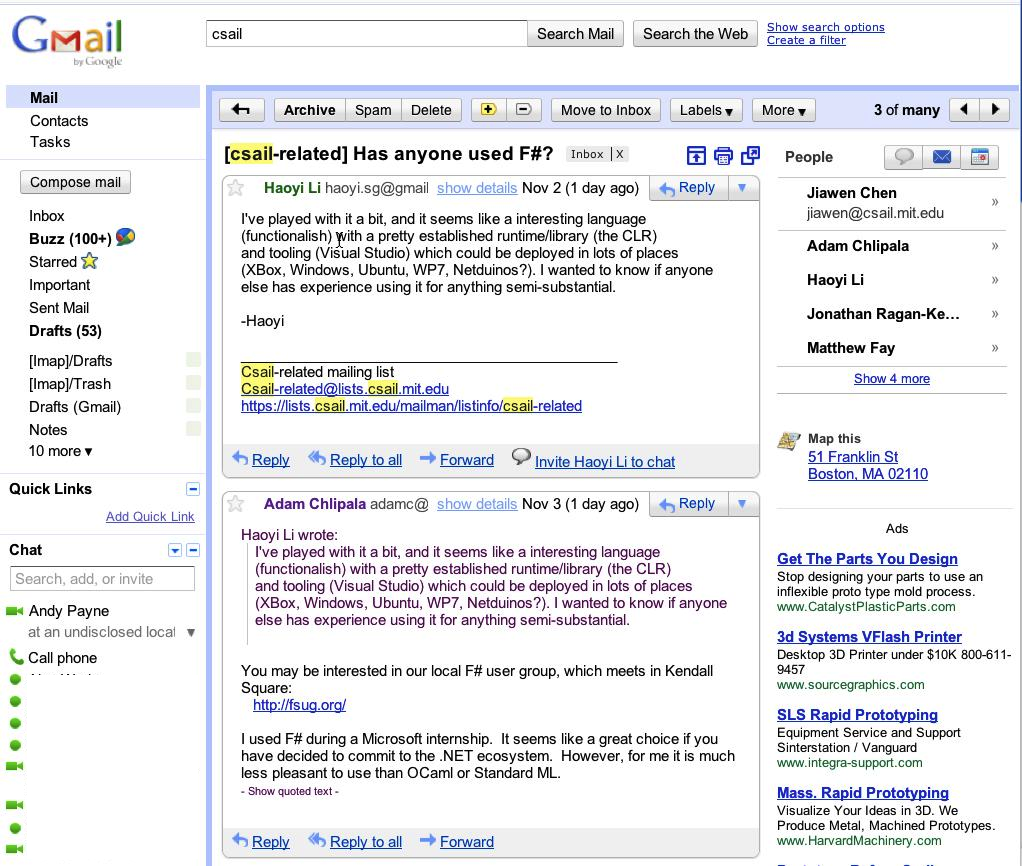
There are some nice usability improvements, such as the ability to reply by just typing into a box.  But by going “cleaner”, Google eliminated many of the subtle but essential visual clues that defined page elements.  Consider the old design:
Now, look at the new design:
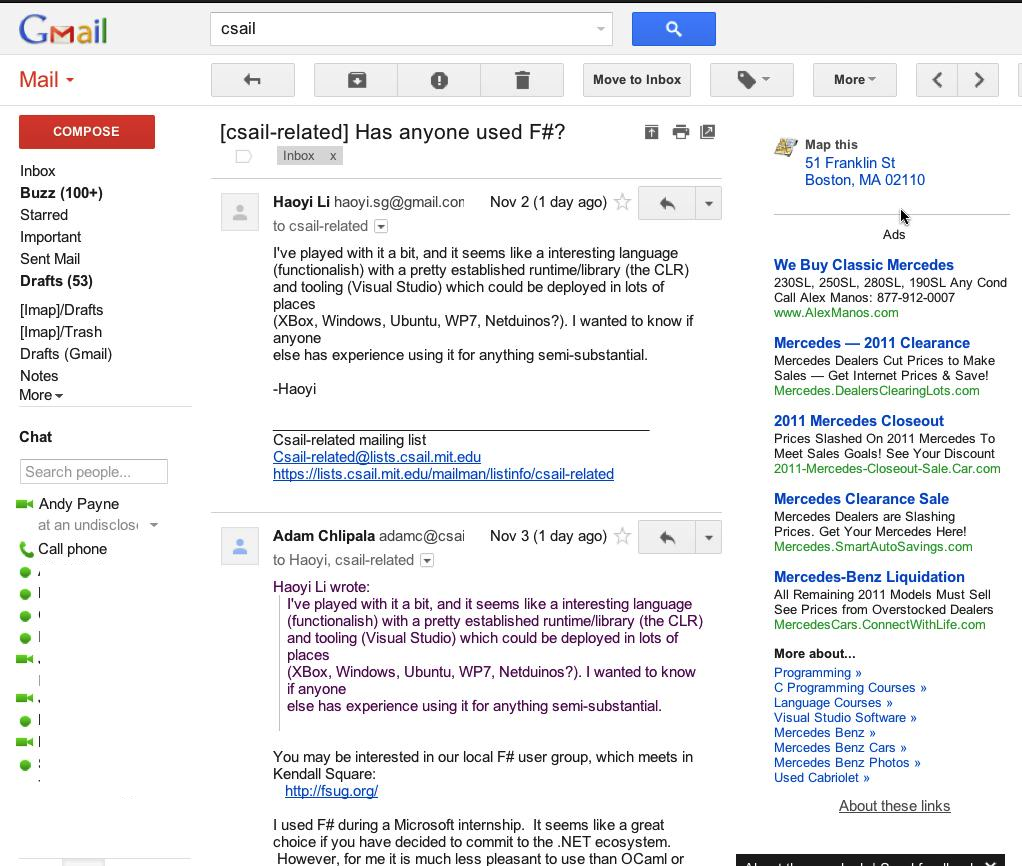
Note how the most important part (the message body text) gets more “lost” in the page.  Button coloring and shading is now too muted, losing important navigation hints.  The rounded box around messages is gone, causing more work to figure out where messages end and begin (and it’s even worse when messages contain quoted replies).  Sender names are no longer colored, making them harder to find as well.   (And themes don’t address the problem — that just provides color and highlighting on the top and left bars).

Considered together, these changes force the user to do much more “visual work”.  For an email app, which is often used in a scanning or skimming mode, this is a critical issue.   It’s also my biggest problem with many UI designs:   most designers do not undertand how our eyes work.  They frequently focus on “aesthetics”, and miss important contrast, color, grouping, layout, and flow details.

I hope Google lets us keep the old design!

The Subtle Power of Git

Unless you’re a software developer, you’ve probably never heard of Git. If I told you it’s a source code version control system, you’re might then think, “who cares?”

Occasionally, a tool comes along that quietly but powerfully changes the way things are done. Git is one of those tools. Developed out of necessity by Linus Torvalds in 2005 to host the Linux kernel, it’s recently exploded in popularity.

For all of its features, Git’s real power is enabling distributed, non-linear development. Because branches are effectively “free”, everything’s done in branches. Developers typically work in their own branches. If a developer is fixing a bug, she might make a new branch, fix, test and commit, then merge that back into a working branch (or the main one).

In contrast, with systems like Subversion, there tends to be much less branching. Developers end up “huddling” around branches, and having to spend much more time coordinating commits. The usual result is that commits are larger and less frequent, which makes merging significantly more difficult.

With Git, developers make small, frequent commits to their own working branches, then they merge that branch into the main one. Often, the merging can be automated: the merger has a much better chance of success with 10 small commits than one big one. Also, Git enables ad hoc sub-projects: two developers working in the same area can merge between themselves, then when done, offer up the combined branch to merge into the main project.

But it’s not enough to just start using Git — if your team uses Git like they use Subversion, you won’t be getting the benefit. You’ve also got to change your development workflows.

Why aren’t you using Git for your project?

Chief User Experience Officer

Steve Yegge’s post about Google’s platform strategy has been making the rounds lately, and buried in it is something very interesting:

Jeff Bezos is an infamous micro-manager. He micro-manages every single pixel of Amazon’s retail site. He hired Larry Tesler, Apple’s Chief Scientist and probably the very most famous and respected human-computer interaction expert in the entire world, and then ignored every goddamn thing Larry said for three years until Larry finally — wisely — left the company. Larry would do these big usability studies and demonstrate beyond any shred of doubt that nobody can understand that frigging website, but Bezos just couldn’t let go of those pixels, all those millions of semantics-packed pixels on the landing page.

Steve Jobs was also an infamous customer experience manager, involved with all Apple products to an intense level of detail.  He has his name on over 300 Apple patents.

It think it’s interesting, and not a coincidence at all, that Apple and Amazon are two of the most powerful companies in the Internet ecosystem.  In the end, it’s all about the user experience.

It helps when the “CEO” is also the “CUXO”, but it’s not the only way to do it.  But it’s hard when there’s not one person that owns the UX, with the authority, vision, drive, charter, energy, charisma, and respect to lead it, throughout the organization.  Committees don’t work.

dmr RIP

I first read about C in the early 80s in BYTE magazine, when they had a full issue on the language.  (According to the archives, it was August 1983).  After learning BASIC, pointers and function declarations really opened my eyes.  It would be several years before I could actually compile anything, but it quickly became my main development language.   My early copy of K&R is quite worn now, and I could quote it, chapter and verse.

In a world of iPhones with one-year half lives, it’s amazing to consider that C has been in use, in nearly original form, for over 40 years, and it’s the basis or major influence for many of today’s mainstream languages.  It’s even more amazing that most machine instructions executed world-wide are compiled C (and C++) programs (and I suspect this is by a wide margin).

C is a simple but brilliant language, and Dennis Ritchie taught us the importance of finding solutions and designs that are simple and elegant.  We will miss him.

Now Netflix Gets Squeezed by Apple/Amazon

I’ve always loved Netflix.  I was a very early subscriber, and we still carry the DVD plan even though we rarely use it (we’ve had some DVDs out for years).   And Reed Hastings has done something that few CEOs and companies have done:  start business A, then successfully build and enter new business B.

But I think they’ve entered a very vulnerable period.   Their streaming deal problems have been well-reported, but there’s a much deeper (and fundamental) issue looming:  they don’t control any user “on-ramp”.

The consumerization of access devices, like tablets, mobile phones, and e-readers gives companies like Apple (and soon, Amazon) immense control.  In some cases, it’s overt (e.g. lack of Flash support, the app approval process, etc.)  In other cases, it’s done by controlling the preferred user experience:  given the new subscription support in iOS 5, why would users want to do subscriptions any other way?

It will be increasingly easy (and cheap) to watch movies on Apple and Amazon devices, gradually squeezing Netflix out of the party.

iOS 5: Apple Taking Over the World

I just upgraded my iPad to iOS 5 — wow!  There’s lots of stuff in there.

What’s most interesting are features that Apple’s pulled in from their app ecosystem. This is great for users (Apple gets to cherry-pick the best ideas).  But it’s risky for app developers who can see their hard work turn into free features, and then deeply integrated in a way that only Apple can do.

I’m making a running list of who’s impacted:

  • Instapaper.  Safari how has a “Read later” feature, and a nice “reader” mode that defeatures Web pages, showing only the content.
  • Web advertisers.  The Reader mode presents text content beautifully, free of ads.  I was wondering when we’d see a main-stream browser with an ad stripper.
  • Twitter.  Deep iOS integration pushes Twitter further into utility space.  More tweets will flow through Apple-controlled UIs, moving Twitter closer to being just a tweet packet router.
  • Wunderlist (and all the other task managers).  Apple can do a TODO list like no other, with location based reminders and voice input (presumably coming with Siri).
  • Wireless carriers.  iMessage (Apple’s response in part to BlackBerry Messenger) is an end-run around text messaging.  It looks like it can work on email handles as well as phone numbers, so kids can start using it with their iPods.

Long term, I see threats to:  

  • Dropbox (and all other file sharing companies).  File sharing is begging to be an OS feature, and iCloud (and Amazon’s Cloud Drive) are moving in that direction.
  • Laptops.  You can now (finally!) activate and use an iPad without a PC, making it a compelling Internet device for users with no other computer. 

Digital Fabrication: Ponoko

Following up on my work on digital fabrication and related areas, I tried Ponoko’s fabrication service.  I didn’t design anything myself (I’m lazy), but I bought a tabbed Arduino enclosure from their marketplace, cut from 3mm clear acrylic.

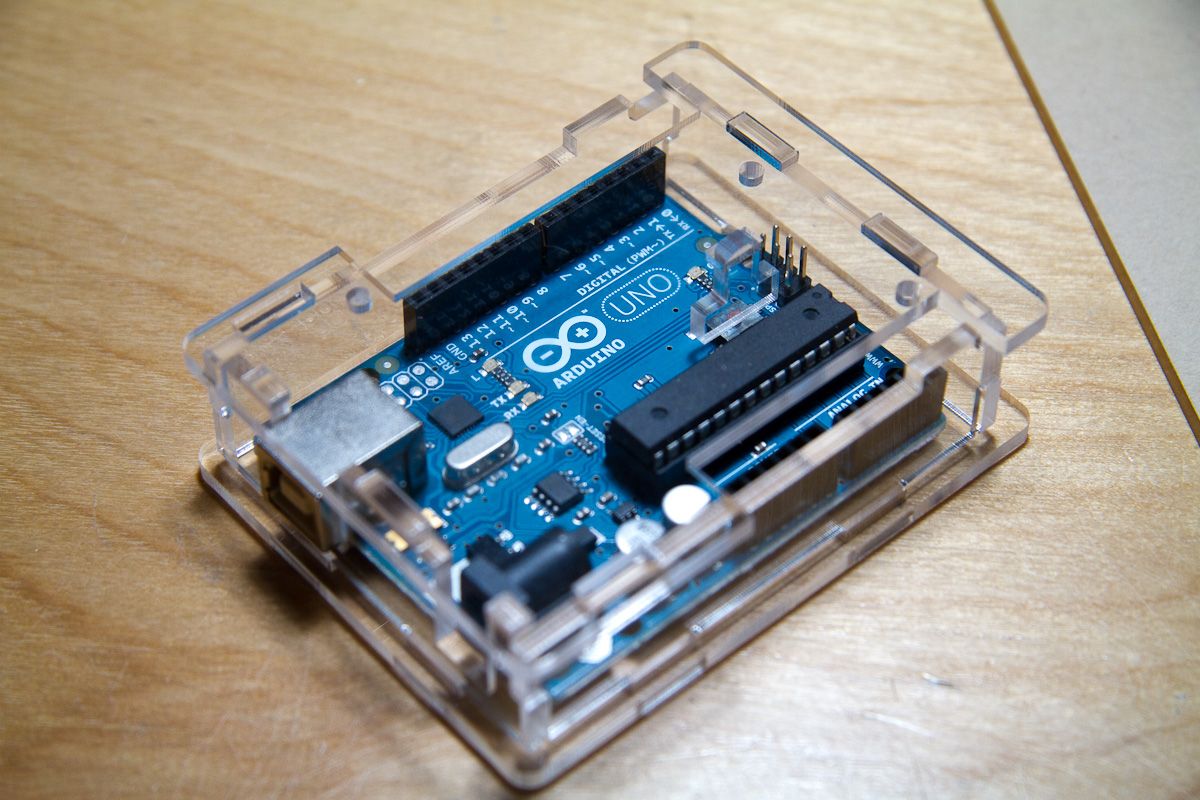
Here’s the 20cm x 20cm laser-cut sheet I got from them:

The cut width was very fine (Ponoko says the line width is about 0.2mm):

And here’s the final case (not glued, and assembled not entirely correctly):

Not bad for $5!  I’m impressed.

I think they’re definitely onto something, but there’s still more work to be done.  In particular:

  • The parts took too long to arrive: 19 days.  In a world where you get stuff from Amazon in 1-2 days, this is way too long.  It took four days to start making my part, 8 days to make and ship it, the 5 days for delivery.  Digital fabrication really sings when you can iterate quickly on mechanical designs (like software does).  At some point, someone will do fabrication overnight and offer “designs submitted by 5pm will ship the next day“, with East and West coast fabrication centers and cheap 1-2 day shipping to most of the US.
  • For 2d/sheet goods, support CAD formats.  Ponoko supports EPS and SVG formats — they’re probably targeting hobbyists and artists.   For mechanical design, they need to support DXF and other CAD formats.  And, they should consider the cut line width with offsets, so they can offer “cut to specified dimension“, which will make it easier to fabricate mechanical parts (such as tabbed enclosures).  Finally, please don’t make me lay out my parts in a fixed format sheet.  Ponoko should optimize the sheet layout (across orders) and just cut out my parts.

It’s the Software, Stupid!

I recently got Kellie a new all-in-one printer/scanner/copier for her office.  After years of buying HP printers, I got tired of their crappy software.  I have no idea why they insist on a multi-hundred megabyte distribution just to support a printer:  they install a bunch of stuff I don’t want/need, and the software I do need isn’t that good.

This time, we bought an Epson (WorkForce 635), and it’s a refreshing difference.  The build quality seems comparable to HP, but the software is much, much more streamlined.

The whole experience underscores something interesting:  the overall usability, quality, and capability of many hardware devices is increasingly defined by software.  Yet many hardware companies fail to prioritize their software design.

Consider this thought experiment:  would you rather have an Android phone running iOS, or an Apple phone running Android?

The Coming Bits and Atoms Disruption

I’ve written recently about the entrepreneurial lottery, and the long odds for many pure-software Internet/consumer/mobile projects.  For the reasons outlined, I’ve been shifting my entrepreneurial energy away from these projects.

Instead, I’ve been working on “bits and atoms”, or as I think about it:  the intersection of mechanical design/fabrication with the Internet ecosystem and Moore’s Law advances. The space includes:  CNC, digital fabrication, the “maker” culture, 3D printing, robotics, sensing, and automation.

I think we’re on the cusp (e.g. next 2-5 years) of some major disruption happening in the mechanical & electromechanical worlds, driven by the convergence of three things:

Internet-enabled collaboration.  Growing up in West Virginia, my technology sources were Popular Electronics and Digi-Key mail-order.  It took forever to build anything, and if someone else did an  interesting project, I was lucky to hear about it years after the fact.  Now, I can surf videos of cool CNC shop projects, and easily contact other makers to share project information.

It’s amazing how fast things can advance when information flows quickly and freely, and when it is easy to build on the work of others.  Consider how, in the span of only about a dozen years, we’ve transitioned from an expensive & proprietary software stack (OS, database, dev tools, etc.), to one that’s completely free, open, higher quality, and much more capable.  That only happened because of the collaboration the Internet enables.

Now, the tools & techniques pioneered by the software community are spilling into the mechanical world:  “open source” designs, version control and configuration management, and collaborative projects.  GrabCAD is one example of a company working in this area. (Disclaimer:  I am an investor).

Moore’s Law advances in computing, storage, and sensors.  The aluminum and screws in a robot arm haven’t changed much in 10 years, but the control computer sure has.  At the top end, a modern Intel/AMD processor has a lot of horsepower for real time image processing, geometry modeling, and control and planning.  At the low end, a Roomba has more CPU capacity than the first desktop computers.  The same advances are happening with storage and sensors:  1TB now costs only $60, and video sensors are getting very cheap.

Many things that were “computationally hard” 10 years ago are now possible.

Modern 3D design tools.   I recently helped a friend rebuild his computing infrastructure after a flood:  $1,200 today buys a very powerful CAD workstation.   Add some parametric 3D design software like SolidWorks, and it’s absolutely amazing what you can prototype, design, test, refine, and stress entirely at your desktop.  When you mix in collaboration:  the ability to take someone else’s model, make your own improvements, and contribute it back, things really start to take off.

I don’t know where it all leads, but it certainly feels like something’s brewing.

Don’t Get Greedy

First, Groupon reportedly turns down $6b from Google.  I was shocked when I heard that, and then stunned when I saw their financials filed with the SEC.  Now, they’re surrounded by competitors, pulling their IPO, and the SEC is questioning the CEO’s leaked all-hands memo for violation of quiet period rules.  I wonder if they wonder about the Google offer.

Now, Business Insider is reporting that Dropbox turned down $800m from Apple.   I suspect (without data), that Dropbox is much less unprofitable than Groupon, but I’m still shocked.  iCloud isn’t perfect, but Dropbox’s long-term risk is that file sharing becomes an OS & app feature.

Don’t get greedy!